Long Island, New York
Independent practices. One negotiating voice. Nobody gives up anything.
A clinically integrated network of independent psychiatric practices on Long Island, New York — owned by its member practices and forming now.
No commitment. We'll follow up in person.
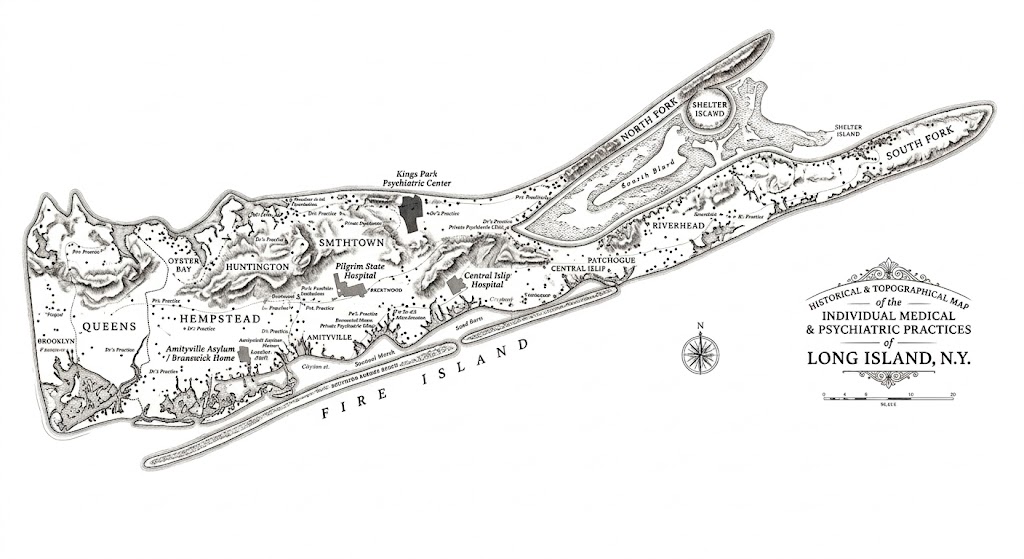
A map of the individual medical and psychiatric practices of Long Island — the ground this network is being built on.
The network is funded by a flat fee. It never takes a percentage of member revenue — not of claims, not of collections, not of anything.
That prohibition is written into the network's operating agreement, and changing it takes the unanimous consent of the founding practices.
Independent psychiatric practices on Long Island should be able to stay independent.
IPG of Long Island exists so that the practices who choose to remain their own can negotiate once, together, and see the terms before anyone is bound by them.No practice gives up its name, its clinicians, or its way of working. Each remains its own business, with its own patients and its own schedule.We keep the group small enough that its members know each other, and serious enough about quality and data to be worth a health plan's time.
What it is, and what it isn't
It is
A member-owned New York entity that holds payer contracts on behalf of its members under a clinical integration program, runs shared clinical protocols with a quarterly practice review, and offers shared services that members can take or leave.
It isn't
A merger, a group practice, a management company that owns anything of yours, a billing company you must use, or a profit-sharing arrangement. There is no common tax ID for clinical revenue. Your claims stay your claims.
Your practice stays yours.
Ownership, finances, staff, EHR, billing, schedule, cash-pay policy. Untouched.
Private practitioners only.
Hospital- and health-system-employed groups aren't eligible, by design. This network is owned by independent psychiatric providers.
Nothing is bundled.
Billing, credentialing, prior auth, group purchasing: each is opt-in, priced separately, and never a condition of membership.
Why now
Independent psychiatric providers deliver most of Long Island's outpatient psychiatric care, and every one of us negotiates alone. Each practice signs whatever fee schedule it is offered. The groups that get a different conversation are hospital systems and venture-backed intermediaries, and both take a share of provider revenue in exchange.
Meanwhile, New York's behavioral health network adequacy rules now require insurers to get patients an initial outpatient appointment within 10 business days, or seven calendar days after a hospital discharge, and to cover out-of-network care at in-network cost when they can't. Plans must certify compliance annually. A network that can guarantee those access standards across Long Island is the answer to a problem every plan now has — not size alone, but a documented access and quality program a payer can rely on.
What members get
- One negotiation instead of one per practice
The network negotiates a single contract on behalf of its members, and you see the terms before you are bound by them.
- A quality program payers can rely on
Shared protocols, measured and reported, so a plan can point to documented access and outcomes across the county.
- A referral channel
Members refer within the network when it serves the patient, and plans can direct members to practices with open access.
- Shared services at network pricing, each opt-in
Billing, credentialing, prior authorization, and group purchasing are available at negotiated rates and never required.
- Quarterly benchmarking, in aggregate
You see how your practice compares on access and quality measures without any practice's figures being identified.
- A vote
Each member practice has a say in the budget, the protocols, and the terms the network is willing to accept.
The clinical program
Clinical integration means the member practices agree to work to the same standards and to measure whether they are meeting them. Seven protocol areas:
- 1Access
An initial outpatient appointment within 10 business days, and within seven calendar days of a hospital discharge.
- 2Measurement-based care
Validated symptom measures recorded at intake and at defined intervals, and used in treatment decisions.
- 3Medication safety
Shared standards for controlled substance prescribing, metabolic monitoring, and registry checks.
- 4Suicide risk
Structured screening, documented risk formulation, and a safety planning protocol every member practice follows.
- 5Care coordination
Defined communication with primary care and other treating clinicians, with the patient's consent.
- 6Transitions of care
Contact after a hospital or emergency department discharge within a set number of days, and documented follow-through.
- 7Telehealth and documentation standards
Common expectations for when telehealth is appropriate, how it is documented, and what the record must contain.
Who's eligible
- An independent psychiatric practice with a location on Long Island, New York.
- No physician in the practice is employed by a hospital or health system.
- The practice agrees to participate in the clinical program and the quarterly practice review.
- The practice pays the flat monthly fee per prescriber and holds a vote in the network.
The fee
Members fund the network with a flat monthly fee for each prescriber in the practice. The board approves a budget for the year, subtracts revenue that isn't dues, and divides the remainder across the network's prescriber FTEs. That is the whole calculation.
Every member sees the budget, every expense, and the network-wide dues totals in the members' portal. There is no percentage of claims, no share of collections, and no line item a member cannot inspect.
Fee = (approved annual budget − other revenue) ÷ member prescriber FTEs ÷ 12
Fixed for the year. No special assessments without a two-thirds board vote. Never a percentage of claims, collections, or anything else.
Where things stand
Fall 2026Now
Founding practices meet, review the structure with health care counsel, and sign the participation agreement.
Early 2027
The entity is formed, the board is seated, and the clinical program is adopted.
Mid 2027
The quality and data program goes live across member practices; baseline measurement begins.
Late 2027
The network opens contract conversations with plans, with terms brought back to members before anything is signed.
2028
First contracts in effect; membership opens to additional independent practices in the county.
Looking for care?
A few questions people ask before they call an office, and where to find a practice in Long Island.
- What does a psychiatric provider do?
- A psychiatric provider diagnoses and treats mental health conditions. That includes psychiatrists, who are medical doctors, and psychiatric nurse practitioners and physician assistants. They can assess what's going on, prescribe and manage medication, and work alongside a therapist. Some also offer talking therapy themselves.
- How is a psychiatric provider different from a psychologist or therapist?
- Psychiatric providers have medical training and can prescribe medication. Psychologists, social workers, and counsellors provide talking therapy but generally cannot prescribe. Many people see both, and the two work together.
- What happens at a first appointment?
- The first visit is usually longer than the ones that follow. The psychiatric provider asks about what brought you in, your history, your physical health and any medication you take, then talks through the options with you. Nothing is decided without you.
- What do these practices treat?
- Independent practices across Long Island see adults, and some see children and older adults, for depression, anxiety, bipolar disorder, ADHD, trauma, OCD, sleep problems, and substance use. Each listing names the areas that practice works in.
Express interest
Tell us a little about your practice and we'll follow up to set up a conversation.